
Average Manufacturing Salaries in Israel 2026

Manufacturing: Salary Table (₪ gross / month)
The ranges reflect market benchmarks in Israel for 2026. Figures are shown for full-time positions and exclude overtime, shift premiums, bonuses, and additional compensation unless stated otherwise.
Manufacturing: roles and salary ranges
Columns: 0–2 years / 3–5 years / 6+ years / Lead (senior, team lead, shift/line supervisor, manager), where applicable. All ranges are in ₪ gross per month.
| Position | 0–2 years | 3–5 years | 6+ years | Lead / Manager |
|---|---|---|---|---|
| Production Manager | 13,600–17,600 ₪ | 15,600–21,400 ₪ | 17,800–25,200 ₪ | 22,400–32,600 ₪ |
| Production Floor Manager | 12,800–16,600 ₪ | 14,600–19,400 ₪ | 16,800–23,400 ₪ | 20,600–29,800 ₪ |
| Department Manager | 12,200–16,200 ₪ | 14,200–19,000 ₪ | 16,400–22,400 ₪ | 19,600–28,000 ₪ |
| Shift Supervisor | 9,800–12,200 ₪ | 11,200–14,200 ₪ | 12,200–16,000 ₪ | — |
| CNC Machine Operator | 9,400–11,800 ₪ | 10,800–14,200 ₪ | 12,200–16,400 ₪ | — |
| SMT Operator | 8,800–11,200 ₪ | 10,200–13,200 ₪ | 11,800–15,400 ₪ | — |
| Machine Operator | 7,800–9,800 ₪ | 8,800–11,200 ₪ | 9,800–13,200 ₪ | — |
| CNC Programmer | 11,800–14,600 ₪ | 13,600–18,000 ₪ | 16,000–21,400 ₪ | 18,600–26,200 ₪ |
| SMT Programmer | 9,800–12,800 ₪ | 11,800–15,600 ₪ | 14,000–18,600 ₪ | 16,800–22,400 ₪ |
| Machine Programmer | 10,800–13,600 ₪ | 12,800–16,600 ₪ | 15,000–20,000 ₪ | 17,800–24,200 ₪ |
| Quality Control Inspector | 8,400–10,200 ₪ | 9,800–12,200 ₪ | 11,200–14,600 ₪ | — |
| Industrial Electrician | 9,400–11,800 ₪ | 10,800–14,200 ₪ | 12,600–17,400 ₪ | 15,400–21,000 ₪ |
| Welder | 9,400–11,800 ₪ | 10,800–14,200 ₪ | 12,600–17,400 ₪ | — |
| Packer | 6,600–7,600 ₪ | 7,200–8,400 ₪ | 7,800–9,200 ₪ | — |
| Production Worker | 7,400–8,800 ₪ | 8,000–10,000 ₪ | 9,000–11,200 ₪ | — |
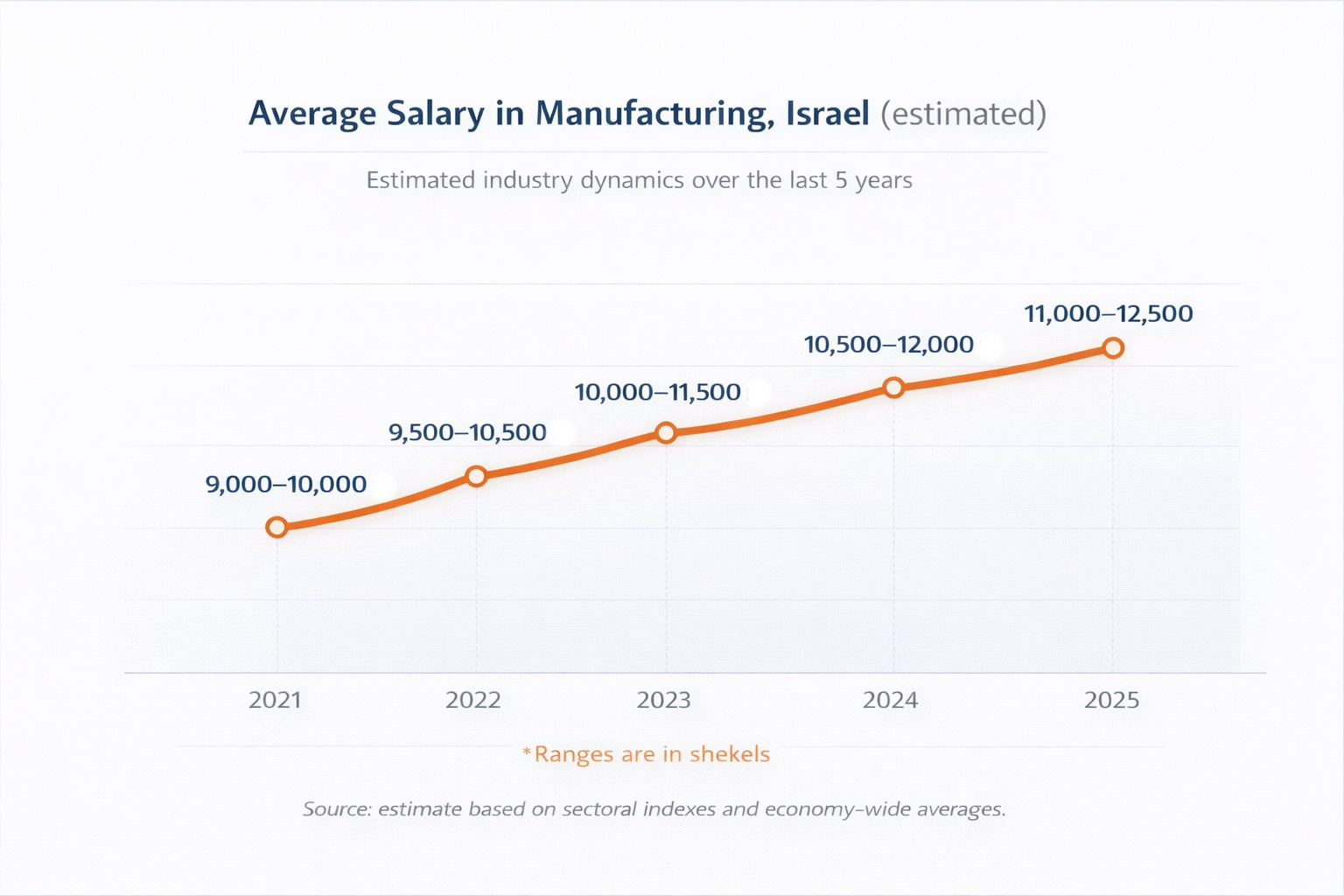
Average manufacturing salary in Israel (updated for 2026)
The manufacturing sector remains one of the core pillars of the Israeli economy. Pay levels are influenced by specialization, experience, shift work, equipment complexity, and level of responsibility.
In 2026, manufacturing salaries are generally higher than the overall base levels in the economy, but lower than industries where bonuses and equity components make up a significant part of compensation. That said, skilled technical professionals (setters, machine programmers, technicians, electricians) and management roles often exceed average market levels.
Operator and shop-floor roles usually define the base ranges, while technical and managerial positions fall into higher compensation brackets.
How to read the salary table and assess offers
Evaluation methodology
The salary ranges are based on a combined analytical approach. The goal is to present a realistic market corridor for each role, rather than isolated minimum or maximum values.
The following factors are considered:
1) Overall labor market trends
Aggregated labor market data and salary dynamics across the economy and the industrial sector.
2) Manufacturing role specifics
Equipment complexity, technical skill requirements, responsibility level, precision demands, and the impact of errors on production.
3) Experience level and role scope
Ranges are calculated by experience bands (0–2 / 3–5 / 6+ years), with senior and management roles shown separately where applicable.
4) Regional and sector differences
Adjustments reflect differences between central areas and the periphery, as well as between manufacturing types (metalworking, electronics, assembly, food production, etc.).
5) Regular updates
Figures are reviewed in line with inflation, demand for roles, and overall economic conditions to maintain relevance.
Comparing correctly: gross, net, and the “total package”
The table shows gross salary (before taxes and mandatory deductions). In practice, it is important to consider:
- Net pay — take-home amount after deductions (depends on family status, tax credits, etc.).
- Premiums — night shifts, Shabbat work, hazardous conditions, and overtime can significantly increase income.
- Benefits — meals, transportation, work clothing, schedule stability, and other perks.
When the salary table may be less relevant
Although the table reflects average market benchmarks, there are situations where actual compensation may differ significantly from the listed ranges.
- Part-time roles or non-standard schedules
Reduced hours, short shifts, flexible arrangements, or seasonal work can lower monthly income. - High share of overtime and shift premiums
In some factories, a large portion of income comes from night, Shabbat, or overtime pay not reflected in base salary ranges. - Actual responsibilities below the job title
The same title may cover different levels of complexity and autonomy. - Facilities under strong budget pressure
Small plants, subcontractors, or high-turnover environments may pay below market even for experienced staff. - Peripheral regions with surplus labor
Areas with excess workforce often offer lower pay, especially for basic roles. - “Senior” titles without managerial authority
Labels such as senior or lead do not always come with higher compensation if responsibility is unchanged.
Examples: checking whether an offer is “in the market”
Example 1: CNC Operator, Northern Israel
Experience: 3 years
Salary: 13,000 ₪ gross
Market range (3–5 years): 10,800–14,200 ₪
Conclusion: The salary is within market range and close to the upper end for this experience level.
Example 2: CNC Programmer, 6+ years
Experience: 7 years
Salary: 19,000 ₪ gross
Market range: 14,000–18,600 ₪
Conclusion: Slightly above market, typically reflecting high autonomy, equipment responsibility, or rare skills.
Example 3: Quality Control Inspector, entry level
Experience: 1 year
Salary: 9,800 ₪ gross
Market range (0–2 years): 8,400–10,200 ₪
Conclusion: Mid-market. Growth potential usually appears after 18–24 months with expanded responsibilities.
Transparency and user contribution
Users may voluntarily submit salary information to improve accuracy.
You can submit data:
- via the website form marked “salary”;
- by email: info@work.co.il with subject “salary”.
Short summary
Salary tables are a tool for a quick “in-market or not” check. For an accurate assessment, always consider experience level, location, actual responsibilities, and the full compensation package.
Frequently Asked Questions (FAQ)
Is this gross or net?
All figures are gross — before taxes and mandatory deductions.
Are bonuses and shift premiums included?
No. The tables show base salary benchmarks only.
Why are salaries lower in the periphery than in central areas?
Differences are driven by demand, factory types, and competition for skilled workers.
How often is the data updated?
Figures are reviewed regularly based on market conditions and inflation.
What if an offer is below market?
Verify role scope, gather comparisons, prepare for negotiation, or consider alternatives.