
Average Logistics & Warehouse Salaries in Israel in 2026

Logistics and Warehouse: Salary Table (₪ gross / month)
The ranges reflect market benchmarks in Israel for 2026. Figures are shown for full-time positions and exclude night shifts, Shabbat premiums, overtime, bonuses, and additional payments unless stated otherwise.
Warehouse: roles and salary ranges
Columns: 0–1 year / 2–3 years / 6+ years / Lead (senior, shift/area supervisor, manager), where applicable. All ranges are shown in ₪ gross per month.
| Position | 0–1 year | 2–3 years | 6+ years | Lead / Senior |
|---|---|---|---|---|
| Warehouse Manager | 11 000–12 000 ₪ | 13 000–15 000 ₪ | 16 000–18 000 ₪ | 17 000–19 000 ₪ |
| Warehouse Worker | 7 400–8 000 ₪ | 8 400–9 000 ₪ | 9 600–10 400 ₪ | 10 200–11 200 ₪ |
| Forklift Operator | 8 000–8 600 ₪ | 9 200–10 200 ₪ | 11 000–12 200 ₪ | 12 000–13 200 ₪ |
| Order Picker | 7 400–8 000 ₪ | 8 400–9 000 ₪ | 9 600–10 400 ₪ | 10 200–11 200 ₪ |
| Sorter | 7 200–7 800 ₪ | 8 200–8 800 ₪ | 9 200–9 800 ₪ | 9 800–10 800 ₪ |
| Packer | 6 600–7 000 ₪ | 7 200–7 800 ₪ | 8 600–9 200 ₪ | 9 200–10 200 ₪ |
| Stock Controller | 10 000–11 000 ₪ | 12 000–13 000 ₪ | 14 000–16 000 ₪ | 15 000–17 000 ₪ |
Logistics: roles and salary ranges
Columns: 0–1 year / 2–3 years / 6+ years / Lead / Manager. All ranges are in ₪ gross per month.
| Position | 0–1 year | 2–3 years | 6+ years | Lead / Manager |
|---|---|---|---|---|
| Logistics Manager | 12 000–13 000 ₪ | 14 000–15 000 ₪ | 17 000–20 000 ₪ | 18 000–21 000 ₪ |
| Shipping Coordinator | 9 600–10 600 ₪ | 11 000–12 200 ₪ | 13 600–15 000 ₪ | 14 500–16 000 ₪ |
| Logistics Administrator | 8 000–9 000 ₪ | 9 600–10 600 ₪ | 12 000–13 200 ₪ | 13 000–14 500 ₪ |
| Distribution Planner | 10 000–11 000 ₪ | 12 000–13 000 ₪ | 15 000–17 000 ₪ | 16 000–18 500 ₪ |
| Supply Chain Manager | 18 000–20 000 ₪ | 21 000–23 000 ₪ | 26 000–30 000 ₪ | 28 000–33 000 ₪ |
| Inventory Controller | 10 000–11 000 ₪ | 12 000–13 000 ₪ | 15 000–17 000 ₪ | 16 000–18 500 ₪ |
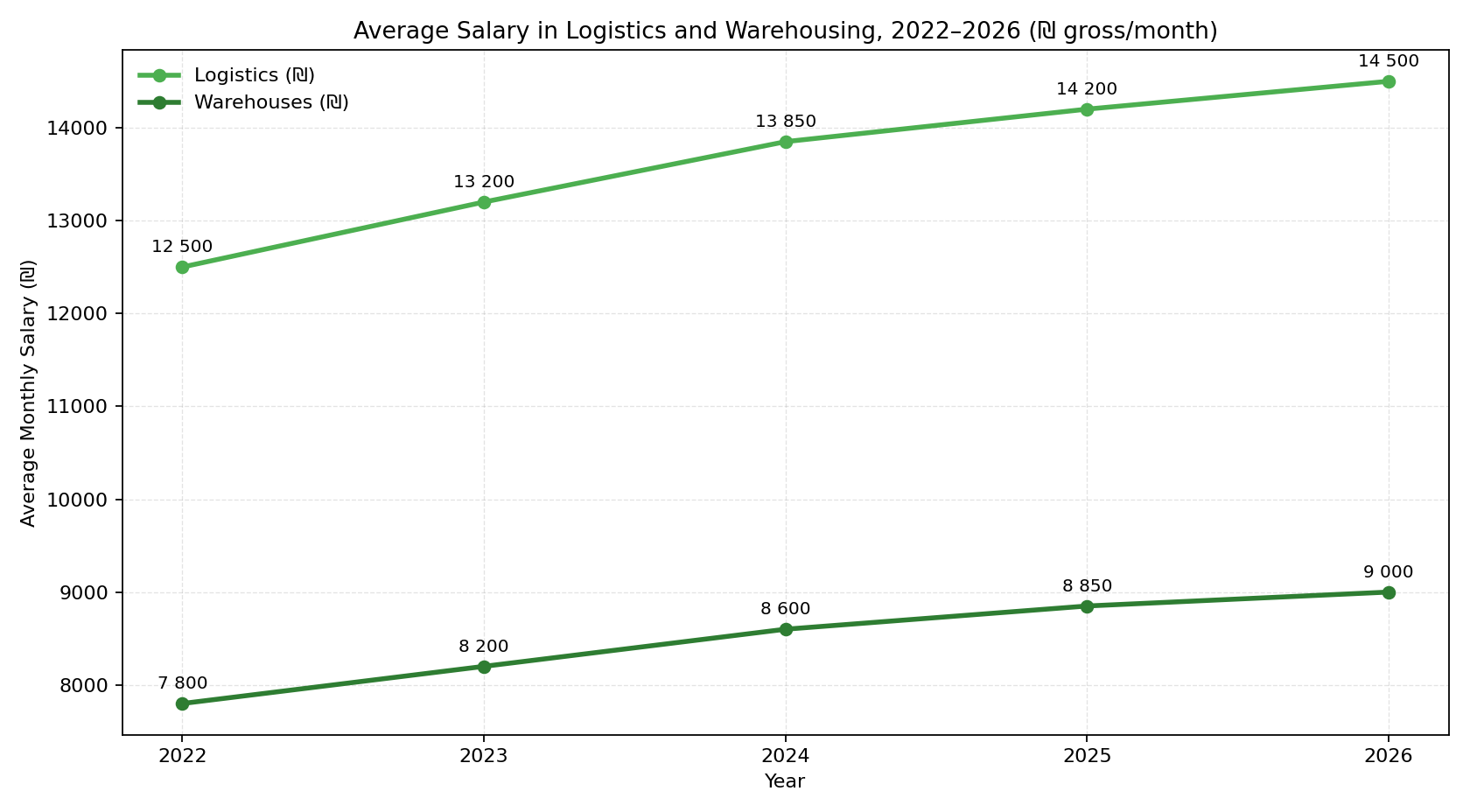
Average salary in logistics and warehousing in Israel (updated for 2026)
Compensation levels in logistics and warehousing depend on company type, operation scale, shift schedule (including Shabbat work), type of goods handled, and responsibility level.
Basic warehouse roles such as picking, sorting, packing, and general warehouse operations form the lower and middle part of the salary range. Positions involving equipment operation and inventory responsibility usually pay higher, while management and supply chain roles belong to the upper segment of the industry.
How to read salary tables and evaluate job offers
Evaluation methodology
Salary ranges are built using a combined analytical approach designed to show a realistic market corridor for each profession.
The following factors are considered:
1) Overall labor market dynamics
Aggregated market salary trends are used as baseline references.
2) Logistics and warehouse specifics
Responsibility for goods flow, inventory accuracy, delivery deadlines, and loss prevention are considered.
3) Experience level and role scope
Ranges are calculated by experience bands (0–1 / 2–3 / 6+ years), with senior and managerial roles shown separately.
4) Regional and sector differences
Differences between central areas and peripheral regions, as well as business types (retail, e-commerce, manufacturing, pharma, etc.), are included.
5) Regular updates
Figures are adjusted in line with inflation and demand for roles.
Comparing correctly: gross, net, and the total package
The table shows gross salary. In practice, it is important to consider:
- Net salary — take-home amount after deductions.
- Premiums — shift work, night hours, Shabbat work, overtime.
- Benefits — transportation, meals, schedule stability, bonuses, and social benefits.
Transparency and user contribution
Users may voluntarily submit salary information to improve accuracy.
You can submit data:
- via the website form marked “salary”;
- by email: info@work.co.il with subject “salary”.
Short summary
Salary tables are a tool for a quick “in-market or not” check. For an accurate assessment, always consider experience level, location, actual responsibilities, and the full compensation package.
Frequently Asked Questions (FAQ)
Is this gross or net?
All figures are gross — before taxes and mandatory deductions.
Are bonuses and shift premiums included?
No. The tables show base salary benchmarks only.
Why are salaries lower in the periphery than in central areas?
Differences are driven by demand, factory types, and competition for skilled workers.
How often is the data updated?
Figures are reviewed regularly based on market conditions and inflation.
What if an offer is below market?
Verify role scope, gather comparisons, prepare for negotiation, or consider alternatives.