
High-Tech Salaries in Israel 2026

High-Tech: Salary Table (₪ gross/month)
Ranges are indicative for the Israeli market in 2026. Figures are for full-time roles, excluding bonuses/RSUs/options.
Development (Programmer)
| Role | 0–2 years | 3–5 years | 6+ years | Lead / Manager |
|---|---|---|---|---|
| Software Engineer | 14,500–21,000 ₪ | 18,500–29,000 ₪ | 26,000–38,500 ₪ | 27,500–40,500 ₪ |
| Software Project Manager | 18,500–25,000 ₪ | 23,000–32,000 ₪ | 29,000–40,000 ₪ | 30,500–42,000 ₪ |
| Other roles (Programmer) | 16,500–23,000 ₪ | 20,500–30,500 ₪ | 27,000–39,000 ₪ | 28,000–41,000 ₪ |
QA / Testing
| Role | 0–2 years | 3–5 years | 6+ years | Lead / Manager |
|---|---|---|---|---|
| QA Engineer | 9,500–14,500 ₪ | 13,000–19,000 ₪ | 17,000–25,000 ₪ | 18,000–26,500 ₪ |
| Automation Engineer | 13,500–19,000 ₪ | 17,000–26,000 ₪ | 23,000–34,500 ₪ | 24,500–36,500 ₪ |
| QA Team Leader | 15,500–19,000 ₪ | 17,000–27,000 ₪ | 24,000–33,000 ₪ | 25,500–35,000 ₪ |
| Head of Automation Team | 17,500–23,000 ₪ | 20,500–31,000 ₪ | 27,500–37,000 ₪ | 29,000–39,000 ₪ |
| Other roles (QA) | 12,500–17,500 ₪ | 15,500–24,000 ₪ | 21,000–30,500 ₪ | 22,000–32,500 ₪ |
Hardware
| Role | 0–2 years | 3–5 years | 6+ years | Lead / Manager |
|---|---|---|---|---|
| ASIC / VLSI Engineer | 17,500–23,000 ₪ | 20,500–29,000 ₪ | 26,000–36,500 ₪ | 27,500–38,500 ₪ |
| RF Engineer | 15,500–21,000 ₪ | 18,500–27,000 ₪ | 24,000–34,000 ₪ | 25,500–36,000 ₪ |
| FPGA Engineer | 15,500–21,000 ₪ | 18,500–28,000 ₪ | 25,000–34,500 ₪ | 26,500–36,500 ₪ |
| Verification Engineer | 13,500–19,000 ₪ | 17,000–26,000 ₪ | 23,000–33,000 ₪ | 24,500–35,000 ₪ |
| Board Design Engineer | 15,500–21,000 ₪ | 18,500–28,000 ₪ | 25,000–34,500 ₪ | 26,500–36,500 ₪ |
| Analog Engineer | 17,500–24,000 ₪ | 21,500–32,000 ₪ | 28,500–40,500 ₪ | 30,000–42,500 ₪ |
| DSP Engineer | 19,000–27,000 ₪ | 24,000–34,500 ₪ | 31,000–44,500 ₪ | 32,500–47,000 ₪ |
| Hardware Project Manager | 19,000–26,000 ₪ | 23,000–34,000 ₪ | 30,500–42,500 ₪ | 32,000–44,500 ₪ |
| Algorithm Developer | 17,500–24,000 ₪ | 21,500–33,000 ₪ | 29,500–43,500 ₪ | 31,000–46,000 ₪ |
| Electro-Optics Engineer | 15,500–21,000 ₪ | 18,500–28,000 ₪ | 25,000–34,500 ₪ | 26,500–36,500 ₪ |
Information Systems
| Role | 0–2 years | 3–5 years | 6+ years | Lead / Manager |
|---|---|---|---|---|
| System Implementer | 10,500–15,500 ₪ | 13,500–20,500 ₪ | 18,000–27,000 ₪ | 19,000–28,000 ₪ |
| BI Developer | 14,000–20,500 ₪ | 18,000–28,500 ₪ | 25,500–38,000 ₪ | 26,500–39,500 ₪ |
| Information Systems Manager | 17,500–24,000 ₪ | 21,500–32,000 ₪ | 28,500–42,000 ₪ | 29,500–44,000 ₪ |
| IS Project Manager | 16,500–22,500 ₪ | 20,000–30,000 ₪ | 27,000–39,000 ₪ | 28,000–41,000 ₪ |
| IT Monitoring | 8,000–11,500 ₪ | 10,000–15,000 ₪ | 13,500–20,500 ₪ | 14,000–21,500 ₪ |
| Network Architect | 16,500–23,500 ₪ | 21,000–33,000 ₪ | 29,500–44,000 ₪ | 31,000–46,000 ₪ |
| IT Manager | 18,500–25,500 ₪ | 23,000–34,500 ₪ | 31,000–46,500 ₪ | 32,500–48,500 ₪ |
| Other roles (Information Systems) | 14,500–20,500 ₪ | 18,000–27,500 ₪ | 24,500–37,000 ₪ | 25,500–38,500 ₪ |
Product Management
| Role | 0–2 years | 3–5 years | 6+ years | Lead / Manager |
|---|---|---|---|---|
| Product Manager | 17,000–23,500 ₪ | 21,000–32,000 ₪ | 29,000–44,000 ₪ | 30,000–46,000 ₪ |
DevOps
| Role | 0–2 years | 3–5 years | 6+ years | Lead / Manager |
|---|---|---|---|---|
| DevOps Specialist | 15,000–21,000 ₪ | 18,500–29,000 ₪ | 26,000–38,500 ₪ | 27,500–40,500 ₪ |
| Senior DevOps | 17,500–24,000 ₪ | 21,500–34,000 ₪ | 30,500–46,000 ₪ | 32,000–48,000 ₪ |
| DevSecOps Engineer | 16,000–22,500 ₪ | 20,000–31,000 ₪ | 27,500–41,000 ₪ | 29,000–43,000 ₪ |
| DevOps Team Leader | 22,500–29,500 ₪ | 26,500–39,500 ₪ | 35,500–52,000 ₪ | 37,000–54,500 ₪ |
| DevSecOps Team Leader | 23,000–30,500 ₪ | 27,500–41,000 ₪ | 37,000–54,500 ₪ | 39,000–57,000 ₪ |
Networks & Infrastructure (Net)
| Role | 0–2 years | 3–5 years | 6+ years | Lead / Manager |
|---|---|---|---|---|
| NOC | 7,000–10,000 ₪ | 9,000–13,500 ₪ | 12,000–18,500 ₪ | 12,500–19,500 ₪ |
| System Administrator | 12,000–17,000 ₪ | 15,000–23,000 ₪ | 20,500–31,000 ₪ | 21,500–32,500 ₪ |
| Senior System Administrator | 14,500–20,500 ₪ | 18,000–28,000 ₪ | 25,000–38,000 ₪ | 26,000–39,500 ₪ |
| Network Engineer | 13,000–18,500 ₪ | 16,500–25,500 ₪ | 23,000–35,500 ₪ | 24,000–37,000 ₪ |
| UNIX Specialist | 13,500–19,000 ₪ | 17,000–26,000 ₪ | 23,000–36,500 ₪ | 24,000–38,000 ₪ |
| Linux Specialist | 13,500–19,000 ₪ | 17,000–26,500 ₪ | 23,500–37,000 ₪ | 24,500–38,500 ₪ |
| Cloud Solutions Architect | 18,500–25,500 ₪ | 23,000–36,000 ₪ | 32,000–48,500 ₪ | 33,500–51,000 ₪ |
| Storage Systems Engineer | 14,000–20,000 ₪ | 18,000–28,000 ₪ | 25,000–38,000 ₪ | 26,000–39,500 ₪ |
| VMware Expert | 14,000–19,500 ₪ | 17,500–27,000 ₪ | 24,000–36,500 ₪ | 25,000–38,000 ₪ |
| Infrastructure Expert | 14,500–20,500 ₪ | 18,000–28,500 ₪ | 25,500–38,500 ₪ | 26,500–40,000 ₪ |
| VoIP Engineer | 12,000–17,000 ₪ | 15,000–23,000 ₪ | 20,500–31,000 ₪ | 21,500–32,500 ₪ |
| Communication Engineer | 13,000–18,500 ₪ | 16,500–25,500 ₪ | 23,000–35,500 ₪ | 24,000–37,000 ₪ |
| Network Technician | 9,000–12,500 ₪ | 11,000–16,500 ₪ | 14,500–22,500 ₪ | 15,000–23,500 ₪ |
| Telephone Systems Technician | 8,500–12,000 ₪ | 10,500–15,500 ₪ | 13,500–21,000 ₪ | 14,000–22,000 ₪ |
| Other roles (Net) | 12,500–17,500 ₪ | 15,500–24,500 ₪ | 22,000–34,000 ₪ | 23,000–35,500 ₪ |
Data Science
| Role | 0–2 years | 3–5 years | 6+ years | Lead / Manager |
|---|---|---|---|---|
| Data Analyst | 12,500–17,500 ₪ | 15,500–24,000 ₪ | 21,500–32,500 ₪ | 22,500–34,000 ₪ |
| Data Scientist | 17,500–24,000 ₪ | 21,500–33,000 ₪ | 29,500–44,000 ₪ | 31,000–46,000 ₪ |
| Database Administrator (DBA) | 14,000–19,500 ₪ | 17,500–27,500 ₪ | 24,500–37,500 ₪ | 25,500–39,000 ₪ |
Information Security
| Role | 0–2 years | 3–5 years | 6+ years | Lead / Manager |
|---|---|---|---|---|
| SOC Operator | 9,000–13,000 ₪ | 11,500–18,000 ₪ | 16,000–26,000 ₪ | 16,500–27,000 ₪ |
| Information Security Analyst | 12,500–17,500 ₪ | 15,500–24,500 ₪ | 22,000–35,000 ₪ | 23,000–36,500 ₪ |
| Cybersecurity Analyst | 13,500–19,000 ₪ | 17,000–27,000 ₪ | 24,000–38,000 ₪ | 25,000–39,500 ₪ |
| Information Security Expert | 15,000–21,000 ₪ | 18,500–30,000 ₪ | 27,000–42,000 ₪ | 28,000–44,000 ₪ |
| Penetration Testing | 14,000–20,000 ₪ | 17,500–28,000 ₪ | 25,000–40,000 ₪ | 26,000–42,000 ₪ |
| Malware Researcher | 15,000–22,000 ₪ | 19,500–32,000 ₪ | 28,500–46,000 ₪ | 30,000–48,000 ₪ |
| Vulnerability Researcher | 15,500–22,500 ₪ | 20,000–33,000 ₪ | 29,500–47,000 ₪ | 31,000–49,500 ₪ |
| Information Security Manager | 22,000–29,000 ₪ | 26,000–40,000 ₪ | 36,000–55,000 ₪ | 37,500–57,500 ₪ |
Average salary in Israeli high-tech (updated January 2026)
According to Israel’s Central Bureau of Statistics, the average salary in the high-tech sector is around ₪32,500 gross per month (average wage for employee positions in high-tech).
This is roughly 2.4 times higher than the average wage across the economy (around ₪13,600 gross per month).
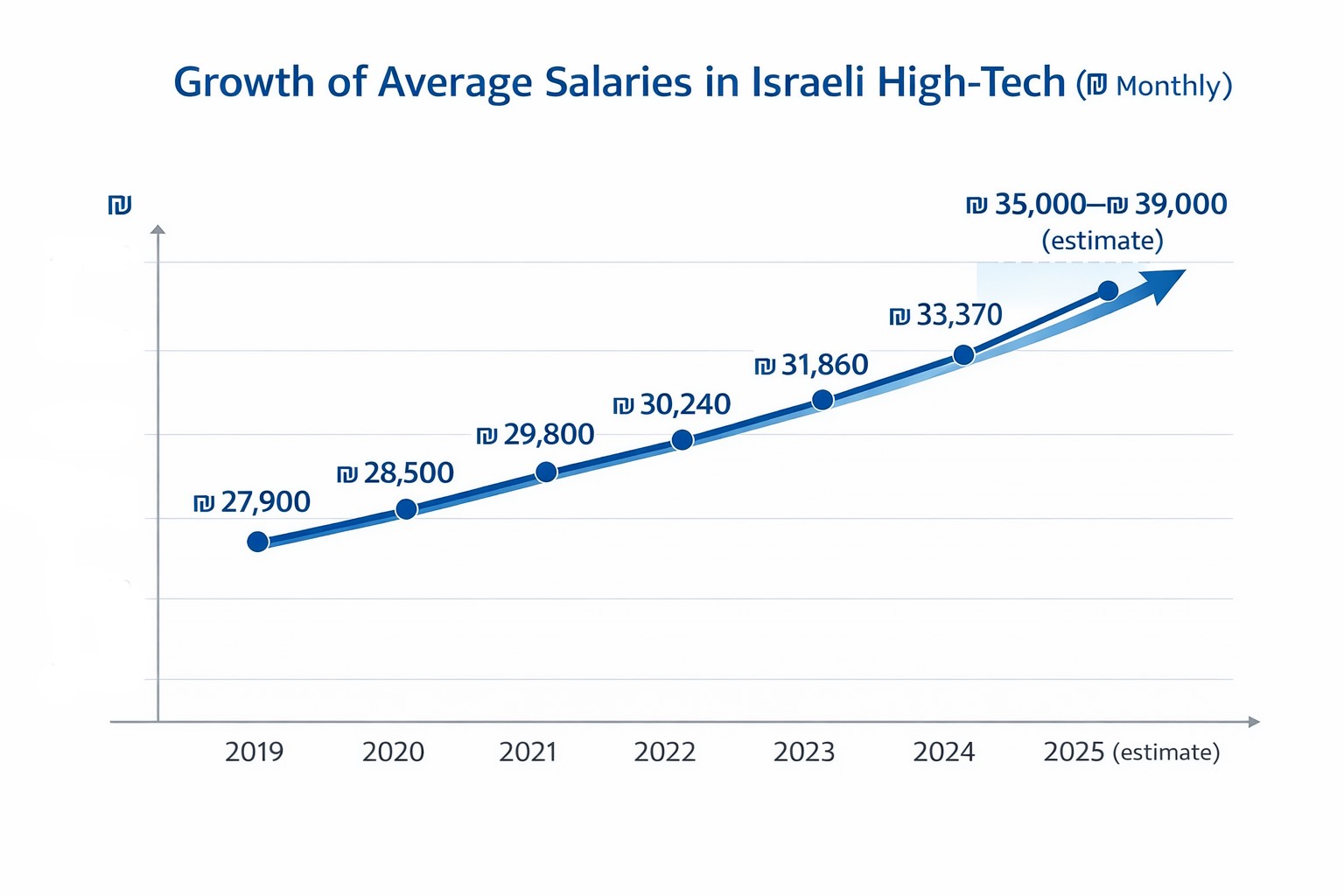
The chart shows the growth trend of the average monthly salary in Israeli high-tech over recent years: from ₪27,900 in 2019 to ₪33,370 in 2024, with a 2025 forecast in the ₪35,000–39,000 range. The trend remains steadily upward, reflecting overall income growth in the sector.
How to read the tables and evaluate your salary
Estimation methodology
The calculations and ranges are built using a blended approach that combines official statistics, industry expertise, and internal analytics. The goal is to provide the most realistic “market range” by profession and seniority level.
Sources and adjustments used in the estimates:
1) Official statistical data
As a baseline reference, we use publications from Israel’s Central Bureau of Statistics (CBS), including average wage figures and labor market dynamics by sector.
2) Adjustments based on industry expertise
To improve practical accuracy, expert adjustments are applied to the statistical baseline, reflecting real hiring conditions, employer offers, and salary dynamics across professional segments.
3) Role level and experience
Ranges are segmented by seniority (entry, mid, senior, management) to capture how tenure, task complexity, and responsibility level affect compensation.
4) Inflation adjustment and regular updates
Figures are reviewed with inflation, seasonal effects, and current market trends in mind to keep the data up to date.
5) Internal data and aggregated feedback
We also factor in internal analytics and aggregated user feedback to refine estimates and increase the reliability of ranges for specific roles.
How to compare salaries correctly: gross, net, and the “package”
The tables show gross amounts (before taxes and deductions). In practice, the employer’s total cost and your take-home pay may differ.
- Gross — the contractual amount before deductions.
- Net — take-home pay after taxes and deductions.
- Total Compensation — base salary + bonuses + RSUs/options + benefits.
- Benefits may include: קרן השתלמות, pension contributions, commuting allowance, meals, insurance.
Examples: “in line with the market” or not
Example 1: QA Engineer, Haifa
Experience: 3 years
Salary: ₪16,000 gross
Market range for 3–5 years: ₪14,000–₪20,000
Conclusion: in line with the market, closer to the middle of the range.
Example 2: Backend Developer, 6+ years
Experience: 7 years
Salary: ₪34,000 gross + annual bonus
Market range: ₪30,000–₪40,000 (excluding bonuses)
Conclusion: in line with the market; the bonus strengthens total compensation.
Example 3: QA Engineer, 0–2 years
Experience: 1 year
Salary: ₪11,000 gross
Market range: ₪10,000–₪15,000
Conclusion: mid-market, with strong growth potential after 18–24 months.
Why ranges can differ (even for the same job title)
- Location: central Israel is often higher than the north/south.
- Company type: startup, outsourcing, enterprise — different budgets.
- Domain: fintech/cyber/AI often pay above average.
- Responsibility level: individual contributor vs. lead/ownership.
- Skill set: rare technologies, English, architecture, product impact.
- Work model: office/hybrid/remote can affect compensation.
Common mistakes when comparing salaries
- Comparing the “top of the range” to a real salary without matching level and scope.
- Mixing central Israel and periphery salaries without adjusting for location.
- Comparing base salary without considering bonuses, RSUs, benefits, and contract terms.
- Assuming the same title always means the same responsibilities.
- Relying on single job postings instead of an aggregated market picture.
Transparency and user participation
To improve accuracy, you can voluntarily share your salary details via the website form or a dedicated contact email.
You can send data:
• via the website form
• by email: info@work.co.il
Short takeaway
Salary tables are a quick tool to check whether you are “in the market range.” For a fair comparison, consider seniority, location, responsibilities, and the full compensation package. If your salary is significantly below market, updating your resume, negotiating, or testing the market with real offers often helps.
Frequently asked questions (FAQ)
Is this gross or net?
The tables show gross amounts (before taxes and deductions).
Do you include bonuses and RSUs?
No. The tables reflect base salary benchmarks. Bonuses and equity vary by company.
Why can Haifa be lower than Tel Aviv?
Differences are driven by regional demand, company mix, and competition for talent.
How often is the data updated?
Figures are reviewed regularly based on market dynamics and inflation.
What should I do if my salary is below market?
Validate role fit (scope/level), collect comparisons, prepare your case, and discuss a raise. Alternatively, go to market and compare real offers.